
 English
 Español
 Deutsch
 Italian
 French
 Turkish
 Thai
 Netherlands
 Português
 Greek
 Arabic
 Danish
 Malay
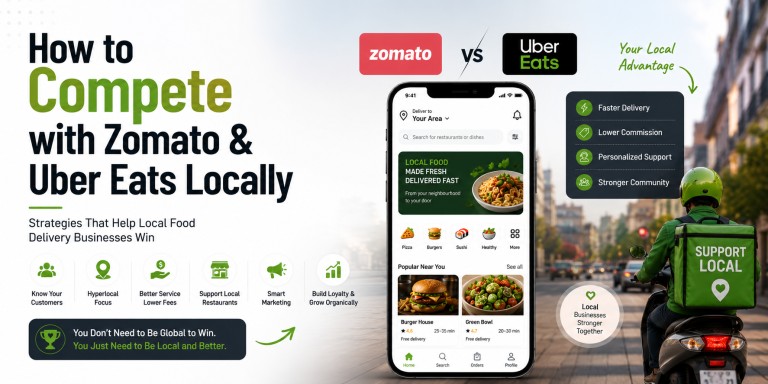
How to Compete with Zomato & Uber Eats Locally
Updated June 2026 · 10 min read · fooddeliveryscripts.com
Zomato takes up to 30%. Uber Eats takes up to 35%. And in return, they own your customer data, your reviews, and your restaurant’s online identity. For small food delivery operators, this isn’t a partnership, it’s a trap.
But here’s the thing: thousands of local delivery businesses are quietly winning against the giants. Not by outspending them, but by outthinking them. They own their platform, keep 100% of revenue, and build loyal customers that the big apps never can.
This guide shows you exactly how to do it step by step.
| 📊 Quick Stat:
Restaurants that own their own ordering platform report 2–3x higher customer lifetime value compared to those relying solely on third-party aggregators. (Source: Hospitality Tech Report 2025) |
>>>>>Why Zomato and Uber Eats Are Actually Vulnerable Locally
The big platforms win on scale and brand awareness. But at the local level, they have serious blind spots:
- They treat every city the same — no local marketing, no community feel
- Their customer support is notoriously slow and frustrating
- They charge restaurants commissions that force higher menu prices
- They show your restaurant next to 200 competitors — you can get lost
- They own the customer relationship, not you
Your advantage as a local operator? You know the neighbourhoods, the peak hours, the customer names. That relationship is worth more than any algorithm.
The Core Strategy: Own Your Platform
The single biggest move you can make is launching your own branded food delivery app. This sounds expensive, but in 2026, it is far more accessible than most operators realise.
With a ready-made food delivery script, you can launch a fully functional platform complete with customer app, restaurant panel, driver app, and admin dashboard in days, not months. The cost is a fraction of custom development.
What Your Own Platform Gets You:
- Zero commission per order — every rupee/dollar goes to you
- Your own customer database — build loyalty programs, send push notifications, run promotions
- Your own branding — customers remember YOUR app, not Zomato
- Full control over pricing, menus, delivery zones, and promotions
- Data: you see what customers order, when, and how often
How to Undercut the Giants on Price (Without Losing Money)
Here is the math that changes everything:
| Via Zomato/Uber Eats | Your Own App | |
| Order Value | ₹500 | ₹500 |
| Platform Commission | ₹150 (30%) | ₹0 |
| Payment Gateway | Included in commission | ~₹10 |
| You Keep | ₹350 | ₹490 |
| Room to Offer Discount? | ❌ No | ✅ Yes — up to 20% |
Even if you pass some savings on to customers as a first-order discount, you still earn significantly more per order and you have built a direct relationship that brings them back.
Winning on Features the Giants Ignore
Big platforms can not afford to customise for every locality. You can. Here are the features that win local loyalty:
GPS Live Tracking
Customers want to see exactly where their order is. A food delivery script with real-time GPS tracking matches or beats what Zomato offers — but under YOUR brand.
Hyper-Local Promotions
Run a “Free Delivery on Rainy Days” campaign. Offer a discount during IPL matches. Target a specific apartment complex with a lunch special. The big apps can not do this. You can.
Loyalty Programs
Your own app lets you reward repeat customers directly. A simple stamp-card style loyalty system increases repeat orders by 40–60% according to industry benchmarks.
Subscription Plans
Offer a monthly “Free Delivery Pass” for a flat fee. This creates predictable monthly revenue and locks customers into your platform — not Zomato’s.
The Local Marketing Playbook
You don’t need a national ad budget. You need hyper-targeted local moves:
- Partner with 5–10 local restaurants on exclusive deals only available on your app
- Hand out QR codes at apartment complexes, offices, and gyms in your delivery zone
- Run WhatsApp broadcast campaigns to your existing customer base
- Get listed on Google My Business with your delivery area keywords
- Collect reviews actively — local SEO for food delivery is shockingly easy to dominate
- Sponsor local events, cricket tournaments, or community groups on Facebook
Step-by-Step: How to Launch Your Own Platform
Here is the practical roadmap to go from zero to live:
- Choose a food delivery script that includes customer app, driver app, restaurant panel, and admin dashboard
- Configure your delivery zones, commission settings, and restaurant onboarding
- Onboard your first 5–10 local restaurant partners with an exclusive launch deal
- Launch a beta to 100 customers in a specific neighbourhood
- Gather feedback, fix friction points, then expand zone by zone
- Use your saved commission money to fund local marketing
| ⏱️ Timeline:
Most operators using a ready-made food delivery script go from purchase to first live order in 7–14 days. Compare this to 6–12 months for custom development. |
Frequently Asked Questions
1. Can a small business really compete with Zomato or Uber Eats?
Yes, but not head-on. The strategy is not to replace them nationally but to dominate your local delivery zone. Customers often prefer a reliable local app with better prices and personal service over a giant platform with inconsistent experience.
2. How much does it cost to build a food delivery app?
Custom development from scratch costs $30,000–$150,000+. A ready-made food delivery script brings this down dramatically and you can be live within days. See our detailed cost breakdown to compare your options.
3. What is a white-label food delivery app?
It is a pre-built delivery platform you brand as your own. It comes with all the components you need: a customer-facing app, driver tracking, a restaurant management panel, and an admin dashboard without writing a single line of code.
4. Do I need to know coding to launch?
No. Modern food delivery scripts are designed for business owners, not developers. Setup is configuration-based, and most providers offer onboarding support.
5. How do I get restaurants to join my platform?
Start by offering 0% commission for the first 3 months. Local restaurants are frustrated with Zomato’s fees and are actively looking for alternatives. A personal conversation beats any pitch deck.
The Bottom Line
Zomato and Uber Eats are powerful, but they are not unbeatable. Their biggest weakness is the same as every giant corporation: they can not be personal. They can not know that Tuesday afternoon is slow in your neighbourhood. Cannot sponsor your local cricket team. They can not send a push notification that says “Your favourite biryani is 20% off today.”
You can. And with a white-label food delivery script, you have the same technology they do — just deployed smarter, at the local level, with your name on it.
| 🚀 Ready to Launch Your Own Delivery Platform?
Stop paying 30% to aggregators. See how Food Delivery Script helps you compete and win locally. |
