
 English
 Español
 Deutsch
 Italian
 French
 Turkish
 Thai
 Netherlands
 Português
 Greek
 Arabic
 Danish
 Malay
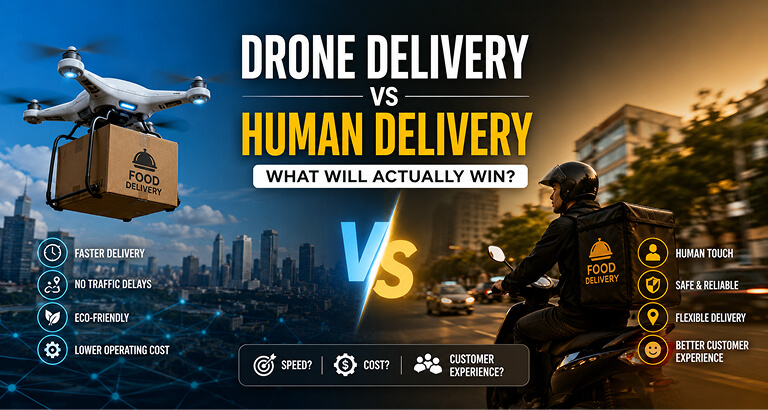
Drone Delivery vs Human Delivery — What Will Actually Win?
Updated May 2026 · 10 min read · fooddeliveryscripts.com
Walk into any food-tech conference in 2026, and you’ll hear the same debate looping at every booth: “How long before drones replace delivery riders?” The answers range from “next year” to “never.” The truth, as usual, is messier and far more interesting for anyone building a food delivery business.
The global drone delivery market hit roughly USD 1.47 billion in 2026 and is projected to reach USD 6.74 billion by 2031, growing at over 35% CAGR. Meanwhile, the human-powered gig delivery economy is still expanding in nearly every major market. Both forces are growing simultaneously, which is exactly why this isn’t a “winner takes all” story.
When discussing drone delivery vs human delivery, the real question isn’t which model will completely dominate the future. Instead, it’s about understanding where each delivery system performs best, how operational costs differ, and what customers actually expect from modern food delivery experiences.
1. The Case for Drone Delivery
Drones aren’t a Silicon Valley pipe dream anymore. Walmart expanded ultra-fast drone delivery across multiple U.S. states in 2026. Uber partnered with Flytrex to roll out aerial delivery. Grubhub just launched a three-month pilot with Wonder and Dexa in New Jersey, offering drone delivery within a 2.5-mile radius. Zipline has crossed one million commercial autonomous deliveries globally.
So what’s driving the momentum?
1. Speed that ground vehicles physically can’t match. A drone flying in a straight line at 50 mph doesn’t care about traffic lights, one-way streets, or a double-parked truck. For suburban orders within a 5-mile radius, drones can shave delivery times from 30 minutes to under 10.
2. Lower variable cost at scale. PwC has projected per-parcel drone delivery costs could drop to around $2 once automation matures undercutting traditional courier economics even after factoring in battery wear and fleet maintenance.
3. A smaller carbon footprint. Electric drones produce far lower emissions than fuel-powered vehicles. For brands chasing ESG goals, that’s a real competitive lever.
4. Contactless by default. Post-pandemic, contactless delivery isn’t a feature it’s an expectation. Drones drop food via tether systems without anyone touching the package.
2. The Case for Human Delivery
Here’s the part that drone evangelists tend to skip: every major food delivery company on Earth still runs on humans. UberEats, DoorDash, Swiggy, Zomato, Deliveroo, Talabat all of them. There’s a reason.
1. Humans handle complexity, drones can’t. Apartment buildings with no rooftop access. Gated communities. Customers who want the bag handed over, not dropped from a tether. A rider can knock on door 4B; a drone cannot.
2. Multi-stop, multi-cuisine routes. A single rider can pick up a biryani from one restaurant, grab a dessert from a bakery two blocks down, and deliver both something a single-payload drone simply isn’t built for. This is why aggregator platforms supporting multi-cuisine and multi-vendor models still lean heavily on human fleets.
3. Payload flexibility. Most commercial delivery drones today max out around 2–5 kg. That family-sized pizza order plus drinks plus sides? You’re back to a human on a scooter.
4. Weather, wind, and reality. Rain, fog, high winds, and dense airspace ground drones routinely. Riders don’t love the rain either, but they keep delivering through it.
5. Regulatory friction. Beyond-visual-line-of-sight (BVLOS) approvals are expanding, but they’re still patchy. The FAA’s dynamic flight corridors aren’t fully integrated with manned aircraft systems, forcing operators to throttle frequency in busy urban skies. Europe’s U-space rules are fragmented across member states. In most cities, you can launch a human delivery fleet tomorrow, a drone fleet might take 18 months of paperwork.
3. Head-to-Head: Where Each Model Actually Wins
| Scenario | Drone | Human Rider |
|---|---|---|
| Suburban, single-restaurant, lightweight order | ✅ Strong fit | Slower |
| Dense urban apartment delivery | Limited landing options | ✅ Strong fit |
| Multi-stop, multi-vendor route | Single payload | ✅ Strong fit |
| Late-night delivery | Restricted in many regions | ✅ Strong fit |
| Rural or hard-to-reach areas | ✅ Strong fit (no roads needed) | Slow, expensive |
| Bad weather | Frequently grounded | ✅ Still operational |
| Heavy/bulky orders (>5 kg) | Capacity limits | ✅ Strong fit |
| Customer interaction (refunds, complaints, missing items) | No human present | ✅ Strong fit |
| Speed for premium “10-minute delivery” promises | ✅ Strong fit | Limited by traffic |
Look at that table honestly and a pattern emerges: drones win on specific routes; humans win on flexibility and edge cases.
4. The Real Answer: Hybrid Delivery Is Already Winning
The “drone vs human” framing is a marketing-friendly debate, not an operational reality. The companies that are actually scaling — Walmart, Uber, Grubhub, DoorDash aren’t choosing one. They’re routing each order to whichever mode makes economic sense for that delivery.
Imagine a single platform that:
- Sends a drone for a coffee-and-pastry order going to a suburban single-family home 3 km away
- Dispatches a rider on a bike for a multi-restaurant order heading to a downtown high-rise
- Uses a car driver for a family-size weekend grocery order
- Falls back to a human when weather grounds the drone fleet
That’s the model that wins. Not drones replacing humans, but smart routing logic deciding in real time. Aggregator platforms built on flexible food delivery scripts are already moving toward this hybrid dispatch architecture, with multi-mode delivery options baked into the core admin panel.
5. What This Means for Food Delivery Startups in 2026
If you’re planning to launch a food delivery business this year or scale one you already run, here’s the practical takeaway: don’t bet your entire business on either extreme.
Going all-in on drones today means waiting for regulations, fighting weather, and limiting your service to a narrow geography. Going all-in on human-only delivery means missing the cost and speed advantages that drone routes will increasingly offer in suburban corridors.
The smart play is building on a foundation that’s mode-agnostic — a platform where you can add aerial delivery zones later without rebuilding your stack. That means:
- A dispatch system that supports multiple delivery types (bike, car, drone-ready)
- Flexible delivery-fee logic based on distance, mode, and zone
- Real-time tracking that works whether the carrier is a rider or a UAV
- A multi-vendor architecture so you’re not stuck supporting one cuisine or one restaurant chain
This is exactly the architecture our Deliware food delivery script is built around admin, restaurant, customer, and rider panels designed to scale across delivery modes. If you want to model your launch on existing market leaders, we also offer purpose-built clones like the UberEats Clone, DoorDash Clone, Swiggy Clone, and Zomato Clone each ready to extend toward drone-ready dispatch when your market is.
So… What Will Actually Win?
Neither. And both.
For the next 5–7 years, expect a clear split:
- Drones will dominate suburban single-payload routes, rural medical and food delivery, and any market with progressive BVLOS regulations.
- Humans will dominate dense urban delivery, multi-vendor orders, complex last-mile handovers, and every market where regulations lag.
- The platforms that win will be the ones that route intelligently across both and own the customer relationship regardless of who (or what) shows up at the door.
The real question isn’t “drone vs human.” It’s whether your food delivery platform is built to accommodate both when the time comes. That decision on the technology stack you choose today is what will actually determine who wins.
 View Live Demo | Get a Free Consultation
Frequently Asked Questions
1. Will drones fully replace human delivery riders?
No, not within the next decade. Drones excel at specific delivery scenarios (short-range, lightweight, suburban) but cannot handle multi-stop routes, complex urban deliveries, or customer-facing situations. Most platforms will run hybrid fleets.
2. Are drone deliveries cheaper than human delivery?
At scale, yes projections put automated drone deliveries at around $2 per parcel versus $6–$12 for traditional courier routes. But the upfront infrastructure, certification, and regulatory costs remain high.
3. Can I integrate drone delivery into my existing food delivery app?
Yes, if your platform is built on a flexible dispatch architecture. Most modern food delivery scripts support multiple delivery modes through API-level integrations with drone operators like Flytrex, Wing, or Zipline.
4. What’s the biggest barrier to drone food delivery?
Regulation. BVLOS approvals, airspace integration, and city-by-city flight corridor rules vary widely and slow commercial rollout significantly more than the technology itself does.
5. Which is better for a food delivery startup in 2026 — drone or human delivery?
Start with human delivery for proven reliability and immediate launch capability. Build your platform on a script that can extend to drone dispatch when your geography and regulations make it viable.
