
 English
 Español
 Deutsch
 Italian
 French
 Turkish
 Thai
 Netherlands
 Português
 Greek
 Arabic
 Danish
 Malay
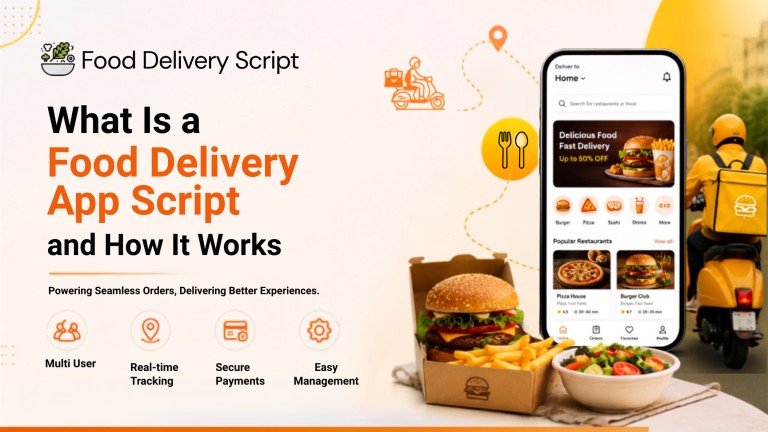
What Is a Food Delivery App Script and How It Works
Updated August 2026 · 10 min read · fooddeliveryscripts.com
Introduction
A food delivery app script is pre-built software that lets you launch an online food ordering and delivery platform without coding it from scratch. It typically includes a customer app, a restaurant panel, a rider app, and an admin dashboard, all connected and ready to customize with your branding. In short, it’s the fastest route from idea to a live delivery business.
What Is a Food Delivery App Script?
At its core, this type of software replicates the functionality of popular delivery apps like UberEats or Zomato, but you own and control it. Instead of spending months building an app from zero, you get a working, tested product on day one.
Here’s what typically makes up the package:
- Customer-facing app – browsing, ordering, and payment
- Restaurant or vendor panel – menu and order management
- Delivery rider app – order pickup and navigation
- Admin dashboard – full platform control and analytics
This structure is why many founders now choose a food delivery clone script over custom development. It cuts both cost and time to market significantly.
How Does a Food Delivery App Script Work?
Once deployed, the platform connects four groups in real time – customers, restaurants, riders, and the business owner. Here’s the flow, step by step:
- A customer browses nearby restaurants and places an order.
- The order lands instantly on the restaurant’s dashboard for confirmation.
- The system assigns a rider automatically or lets the restaurant pick one.
- The rider picks up the order and updates delivery status in real time.
- The customer tracks the order live until it arrives.
- Payment settles automatically between the platform, restaurant, and rider.
Because every step runs through one connected system, there’s no manual coordination needed. That’s the biggest operational advantage over building disconnected tools separately.
Core Components at a Glance
| Component | Purpose | Used By |
| Customer App | Browse, order, pay, track | End customers |
| Restaurant Panel | Manage menu, accept orders | Restaurant owners |
| Rider App | Accept deliveries, navigate | Delivery partners |
| Admin Dashboard | Monitor, manage, analyze | Business owner |
Each piece works independently but stays synced through a shared backend, so updates in one place reflect everywhere instantly.
Who Actually Uses This Kind of Platform?
This isn’t limited to giant food delivery brands. In practice, it fits:
- Independent restaurants wanting their own branded ordering app
- Entrepreneurs launching a multi-restaurant marketplace
- Cloud kitchen operators managing multiple virtual brands
- Regional businesses competing with global delivery apps locally
Why Should You Consider Starting a Food Delivery Business?
The timing matters just as much as the technology, and right now the numbers make a strong case. According to Grand View Research, the global online food delivery market was valued at $355.6 billion in 2026 and is projected to reach $505.5 billion by 2030, growing at a CAGR of 9.4%. That’s not a niche opportunity, it’s a sustained global shift in how people eat.
A few numbers worth paying attention to:
| Metric | Figure | Source |
| Global market size (2026) | $355.6 billion | Grand View Research |
| Projected market size (2030) | $505.5 billion | Grand View Research |
| Market CAGR (2025 to 2030) | 9.4% | Grand View Research |
| Asia Pacific market share | Over 41% | Grand View Research |
| Global market forecast (2031) | $468.51 billion | Mordor Intelligence |
Beyond the headline figures, a few underlying trends make now a genuinely good time to enter the space:
- Urbanization and busier lifestyles continue to push demand for convenience-first ordering, according to Mordor Intelligence’s market analysis.
- Digital payments dominate, with online payment methods accounting for the large majority of order volume, reducing friction for new platforms.
- Regional and local platforms are gaining ground, as consumers increasingly look for alternatives to high-commission global apps.
- Cloud kitchens and multi-brand models are expanding quickly, opening more entry points beyond traditional restaurants.
In other words, you don’t need to out-market UberEats or Zomato to build a profitable business. A well-positioned regional or niche platform, powered by the right food delivery app script, can capture meaningful market share without competing head-on with global giants.
Single Restaurant vs Multi Restaurant Setup
Not every business needs the same structure. Generally:
- Single-restaurant setup suits one brand wanting direct-to-customer ordering, skipping commission-heavy third-party apps.
- Multi-restaurant setup suits marketplace-style businesses onboarding many restaurants under one platform, similar to an on-demand food delivery app clone model.
Both structures typically run on the same underlying software, just configured differently at setup.
Is It Customizable?
Yes, and this matters more than most founders initially expect. A good food ordering script should let you adjust:
- Branding, colors, and app name
- Payment gateways based on your region
- Delivery zones and pricing logic
- Languages and currencies for local markets
Platforms that lack this flexibility tend to feel generic, which hurts user trust and retention over time. If you’re comparing providers, our guide on questions to ask before buying a food delivery script covers exactly what to check before committing.
If you’re still deciding between models, it helps to see how different platforms compare. Our breakdowns of the top trending food delivery clone scripts and how to choose the right DoorDash clone script walk through real feature differences across popular options.
Final Thoughts
A food delivery app script provides a ready-made foundation for launching a scalable online food delivery platform without starting the entire development process from scratch. By connecting customers, restaurants, delivery partners, and administrators in one ecosystem, it can help businesses streamline operations and enter the market faster.
However, choosing the right script is essential. Look for a solution that offers customization, scalability, secure integrations, source code ownership, and reliable technical support so your platform can adapt as your business grows.
Ready to launch your own food delivery business?
Explore our live demo to see the food delivery app script in action, or get a free consultation with our experts to discuss your requirements and discover how you can launch your food delivery platform with the right technology.
Frequently Asked Questions
1. What is a food delivery app script?
It’s ready-made software that powers an online food ordering and delivery platform. It includes a customer app, restaurant panel, rider app, and admin dashboard, letting you launch a delivery business quickly without building everything from scratch.
2. How does a food delivery app script work?
It connects customers, restaurants, and riders through one synced system. Customers place orders, restaurants confirm them, riders handle delivery, and the admin dashboard tracks everything in real time, automating most of the operational workflow.
3. What are the main components of a food delivery app script?
The core components are a customer app, a restaurant or vendor panel, a delivery rider app, and an admin dashboard. Together, they handle ordering, menu management, delivery logistics, and overall platform control from one connected backend.
4. Can a food delivery app script support multiple restaurants?
Yes, most modern scripts support a multi-restaurant marketplace model, similar to major delivery apps. Restaurants can independently manage their own menus and orders while the admin oversees the entire platform from a central dashboard.
5. Can a food delivery app script be customized?
Absolutely. Reliable providers let you adjust branding, payment gateways, delivery zones, languages, and pricing logic. Customization ensures the platform fits your specific market and doesn’t feel like a generic, copy-paste solution to your customers.
6. What makes Bytesflow a good choice for a food delivery app script?
Bytesflow offers a fully customizable, ready-to-launch solution with flexible branding, multiple payment integrations, and dedicated support. It’s built for founders who want a reliable, scalable platform without the delays of custom development from scratch.
